What is a Festool Domino Joiner and why is almost every fine woodworker comparing it favorably to similar but very different woodworking tools? Suffice it to say that the Domino is one of those woodworking tools that defies comparison to other woodworking tools. Is it a biscuit joiner? No, but Im sure that its design concept sprang from that. Heres what a biscuit joiner does: It cuts out half-moon-shaped shallow mortises in the edges of boards to accommodate eye-shaped compressed wooden biscuits. The biscuit joiner cuts an indentical mortise into the mating edge of a second board in a glue-up and this mortise accommodates the second half of the biscuit.
Why use biscuits? Because glue joints sometimes have a habit of opening up over time and this biscuit joining process is supposed to insure that this does not occur in the middle of a dining table or solid cabinet door after it has been delivered and paid for.
So, while the joiner does a great job, it is really a kind of one-trick pony in the world of woodworking tools. If you try to use it for other kinds of joints, like, say, mating a table leg to an apron, you will be disappointed. The biscuit has tremendous lateral strength across its grain. Because it is highly compressed, when the glue hits it, it swells up like a sponge, filling the mortise tightly, making it almost impossible to pull it apart laterally after the glue dries. However, because it is so thin and small, it has very little strength other than lateral and can be snapped off if bending force is applied across its grain. When gluing a leg to an table apron or chair, a biscuit joiner is not your best choice of woodworking tools. A mortise and tenon joint, on the other hand, is.
If you have ever tried to do a tight-fitting mortise and tenon joint with just a hammer and chisel you know how time-consuming and frustrating this process can be: First, the mortise must be chiseled out to its final dimensions. The walls must be smooth and parallel and the bottom needs to be flat. The tenon must be cut precisely to fill the mortise tightly but smoothly. It must be flat and square on all sides and not a bit longer than the mortise is deep. You start with the tenon being too wide and thick for the mortise and then you carefully shave it down until it fits perfectly. If you go just a teeny bit too far in your shaving, you have a sloppy joint and you must throw out the workpieces and start over from scratch. NO!!
There seem to be two kinds of quality woodworkers out there: The first kind are those who are interested in doing things by hand, using old fashioned woodworking tools, no matter how long it takes or how hard it is… just for the pride that comes with a hand-crafted attempt at perfection. The other kind of quality woodworker wants an equal degree of perfection but also knows that time is money and there is now a much better, more accurate, less frustrating way to make a mortise and tenon joint. The Domino Joiner makes perfect mortise and tenon joints over and over again with ease, speed and efficiency. It can make them along flat or beveled glue joints. It can make table legs join to aprons like they were a continuous piece of wood. It can make chair legs mate perfectly to seats and cross bars mate neatly to legs. You can quickly make door frames, cabinet carcasses and picture frames that will stay strongly together virtually forever. Best of all, once the mortise and tenon joint is made, you cant tell it apart from one made the old fashioned way by an old-time craftsman with a hammer and chisel. In fact, it may look better.
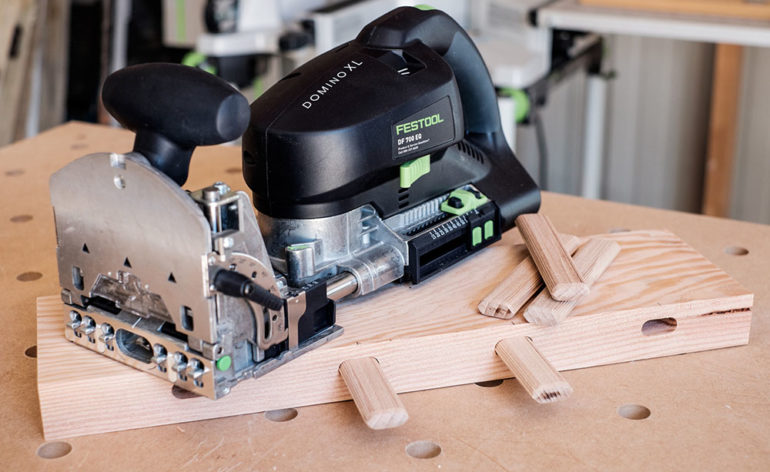
Like a biscuit joiner, the Domino joiner does not make tenons because they are already made to exact size, ready to be inserted into the mortises made precisely by the Domino joiner. The tenons look somewhat like dominoes, hence the name. They are square on the ends but rounded on the side corners. They are scored along the edges to allow glue to escape from the mortise so that the tenon can go to almost the full depth of the mortise. Domino Joiner tenons are made in several, specific thicknesses, matched exactly to the particular cutting bit designed for that size tenon. Each tenon is nominally twice the depth of each mortise. The joiner makes identical mortises in the pieces to be joined so the tenons are just short of approximately 2 times the depth of each mortise to insure a tight fit along the shoulders of the joint.
Unlike a biscuit joiner, mortise and tenon joints made by the Festool Domino joiner have strength in all directions because the mortises are deeper and the tenons are stronger and larger than biscuits. The grain runs the length of the tenon, not across it like the biscuit and the tenon is usually thicker than the biscuit. The mortise made by a biscuit joiner is approximately ½ or less at its deepest part while the Domino tenons go far deeper and do so to a consistent depth across the floor of the mortise.
While the mortises made by the Domino joiner are cut tight to the thinner thickness dimension of the Domino tenon, they are cut a bit loose near the rounded corners so that they can allow for slight inaccuracies in the placement of the mortises and so that the workpieces can be shifted slightly during glue-up if need be. This is why they are called “floating tenons.”
The dominoes are rounded on the sides because the machine cuts mortises with round ends equal to the diameter of the cutter being used at the time. There are four different diameters of cutters available. Cutter bits last between 4000 and 15,000 mortise cuts depending on the hardness of the wood and if the mortises are being cut into side grain or end grain. The bits are carbide tipped and can be re-sharpened 1-3 times although it is probably easier to just buy a new bit. If you take your index finger and wave it left to right you can see how the Domino cutter works while it is spinning around at over 25,000 RPM. This means that, unlike a drill bit that is stuck in its own hole with no way to vent out the friction heat, the Domino cutter is freely cutting in open air which means that the bits last a lot longer because they are not overheating. The interval between sharpening or bit replacement is an important economic consideration when shopping for woodworking tools that are going to be used a lot.
I could go into great detail about how the Festool Domino Joiner is adjusted, how the cutters are changed, how the fence is angled to make mortises in beveled joints, how spring loaded locator pins let you make repetitive mortises along the opposing sides of a glue joint, about how the depth of the mortises are set to match the tenons being used, about how the fence is adjusted as to height to locate mortises precisely in the glue joint, etc., etc. etc. If you decide to add a Domino joiner to the list of woodworking tools you own, just know that it comes with an excellent instruction manual that will show you every possibility and technique in great detail.
This gem among woodworking tools works with you in elegant simplicity: Pick out the right tenon size for the job, install the proper cutter for that tenon size, set the mortise depth to half of the tenon’s nominal length and then push on the machine to plunge the mortise right where you want it.
At this point, all you really need to know is if you are ready, willing and able to buy this accurate and easy to use woodworking machine. “Ready”, in the sense that you have a legitimate need for such a device, “willing” in that you want to make a substantial investment into a specialty tool and “able” in that you have the financial resources to pay for it. This is a production tool as well as an accuracy tool. If you are not doing production work, you might not need it enough to justify the price tag. On the other hand, if accuracy and production efficiency are your primary goals, the Festool Domino Joiner may find a justifiable home in your workshop. Assuming that you have the money available to consider investing $700 in the joiner, plus the tenons, plus a matching Festool portable vacuum system, you might want to ask yourself how much you would actually use a specialized machine like this. The decision to buy or not buy woodworking tools always comes down to production and profit. Time is money. Quality is money. Quality delivered quickly, over and over again can make woodworking a profitable business. Woodworking tools that can deliver this production value are always worth the money. Old school perfectionists can be very proud of their hammer and chisel wizardry but they will never get rich because what they are doing is taking too long and time, my friend, is money.
In the end, it comes down to accuracy vs. money. There has been a lot of short-sighted chatter on the woodworking blogs about this joiner and it is almost always about how expensive it is. Festool entered the market a few years ago with a line of the highest quality, most expensive, most inventive, well-thought out woodworking tools imaginable. Its just like the auto industry. There are Hyundais and there are Mercedes. Both sell well in good times because they fill different needs. There are always customers for both of them. You simply need to identify what type of customer you are by knowing, in advance, what your needs are in terms of woodworking tools.
The Festool Domino joiner has been called the most significant tool development in years. It is one of a kind (for now). It does its job well: It is easy to use and delivers precise results quickly.
If you are a professional woodworker, making repetitive mortise and tenon joints by hand, would you jump at a chance to make many, many times the cost of the machine in terms of time saved and accuracy achieved easily? What kind of woodworker are you? What kind of woodworking equipment do you need to do what you do? Can you justify the expense or not. I cannot answer that question for you but Im willing to bet that, at this point, you can.
One warning: Owning this can be addictive. The Domino joiner is one of many fine woodworking tools made by Festool. It is almost guaranteed that if you purchase your first Festool, the second Festool will come into your life a lot sooner than you ever expected.
Festool also has a product-wide system of containers (called Systainers) to hold woodworking tools, attachments and supplies. You only need one Festool vacuum and one Festool hose to keep your shop practically dust and chip free because it fits all tools sold by Festool. Once youve bought a Festool vacuum and hose, you are in the Festool system, making it easier to justify the next Festool purchase. Clever, those German engineers!
Festool has clearly identified a marketing niche is comprised of fine woodworkers who know that the best woodworking tools, the most expensive woodworking tools, built to last usually end up being the most economical kind of woodworking tools in the long run because they keep doing the quality thing quickly over and over again. That adds up to production efficiency that justifies the cost.
If I had just one woodworking job to do, I would buy a cheap tool. I could later justify throwing it in a drawer and forgetting about it because its cost had already been justified. If I did the same job, over and over again, every day, for a living, Id want the best, most accurate, well-made tool I could find at any price.
FESTOOL DOMINO JOINER SPECIFICATIONS
Front fence tilts with detents at 0, 22.5, 45, 67.5 and 90 degrees.
Spring-loaded guide pins index Domino to make precisely located mortise cuts.
Friction pads keep Domino from slipping against workpiece during cut.
Height selection scale has stops at 16mm, 19mm, 22mm, 28 mm, 36 mm and 40mm.
Depth of cut scale has stops at 12mm, 15mm, 20mm, 25mm and 28mm to match tenon lengths.
3 mortise widths possible.
Bit sizes are 5mm, 6mm, 8mm and 10mm in diameter.
Machine weight is 7 Pounds.
Power Usage 420 Watts.
Speed of cutter is 25,500 RPM.
Maximum Mortise Depth is 28mm.
Maximum Mortise width is 23mm
Double Insulated.
Basic Domino Systainer includes:
Domino Joiner
Power Cord
Support Bracket
Wrench
Documentation
Cross Stop and Trim Stop with Instructions