QUICK NOTE: To buy any product reviewed below, click on the Buy Now button to go directly to the appropriate page on another secure site to get more information on that product and/or make a purchase. The “Bob’s Pick” logo below indicates which of the products below has earned Bob Gillespies highest purchase recommendation. Below the reviews is a SIDE-BY-SIDE COMPARISON CHART and, finally, an article by Bob Gillespie on important features to consider when shopping and why.
QUINCY MODEL 2V41C60VC 5HP, 60 GALLON AIR COMPRESSOR
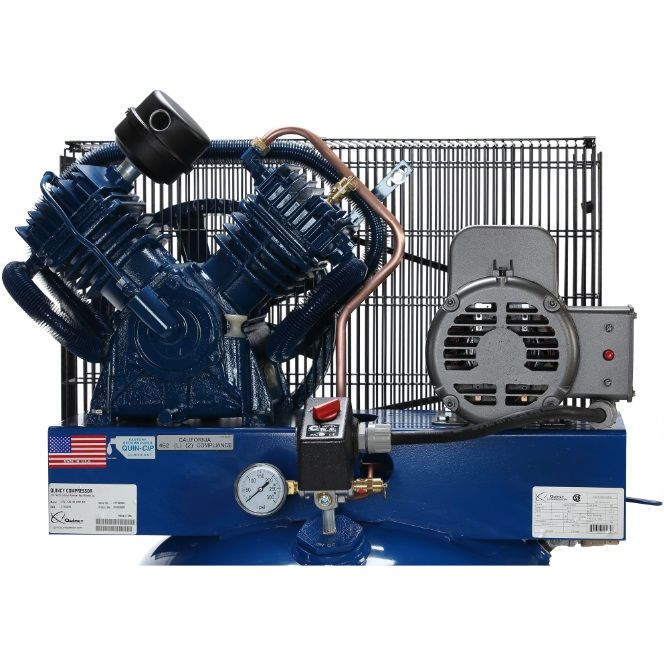
This is the smallest air compressor I would consider to run a single air sander. Its single-phase motor runs on 230V AC. Quincy compressors run slower than most competing brands which means they run cooler and cost less to operate. They apparently last longer considering that Quincy rates its compressor pumps at an amazing 50,000 hours. Air output from this air compressor is 15.2 CFM. Maximum tank pressure is 175 PSI. The pump is two-stage and the motor is the capacitor start type with thermal overload protection. Machine weight is 417 Lbs. This air compressor is priced at around $1400.
CAMPBELL HAUSFELD CE 7501 5 HP, 80 GALLON AIR COMPRESSOR
This air compressor should run a single air sander continuously. Its single-phase motor is rated at 5 HP and runs on 230V AC power. Maximum tank pressure is 140 PSI which is lower then the 175 Lb. norm.. Air delivery is rated at 16.1 CFM. The cast iron pump is oil lubed. This air compressor sells for about $2000.
INGERSOLL RAND SS5L5 5HP, 60 GALLON AIR COMPRESSOR
Ingersoll Rand air compressors are rated top-quality in the business and usually sell at a slightly higher price. This single stage Ingersoll Rand air compressor has a single phase, 230V motor and a 60 Gallon tank. This compressor is rated at 135 PSIG and produces a 15.5 CFM air output. Street price is about $920.
CAMPBELL HAUSFELD CE 7000 7.5 HP, 80 GAL. AIR COMPRESSOR
Again, this 7.5 HP, 3 Phase-powered air compressor should run 2 air sanders at the same time. It has an 80 gallon ASME tank. The air compressor motor has a magnetic starter and thermal overload protection. Air delivery is 23.7 CFM at 175 PSI, the maximum tank pressure. Campbell Hausfeld states that their air compressor pump life should exceed 10,000 hours. The CE7000 air compressor weighs 540 Lbs. and costs around $2560.
INGERSOLL RAND 2475N7.5-P 7.5HP, 80 GALLON AIR COMPRESSOR
Look for top quality at a slightly higher price in this Ingersoll Rand “Type 30” air compressor. The motor that comes with this model is 3 Phase. However, an, otherwise identical, single phase air compressor is also available from the same manufacturer. Important extras included are an automatic tank drain valve, an after-cooler and a low oil level interrupt switch. Max tank pressure is 175 PSI. The V-pump is cast iron. A finned copper intercooler is built in. Price for this air compressor is around $2500.
INGERSOLL RAND 2545K10-P 10 HP, 120 GALLON AIR COMPRESSOR
This 3-phase, 10 HP air compressor delivers 35 CFM of air at maximum tank pressure of 175 PSI. Included are a finned copper intercooler, automatic drain, a low oil level interrupt switch and an after cooler. Price tag on this top-quality Ingersoll Rand compressor is around $3800.
SIDE-BY-SIDE COMPARISON CHART: AIR COMPRESSORS
| Abbreviations: | |||||||||
| CH = Campbell Hausfeld | |||||||||
| IR = Ingersoll Rand | |||||||||
| Q = Quincy | |||||||||
| Q – 5HP | CH – 5 HP | IR – 5 HP | CH – 7.5 HP | IR – 7.5 HP | Q – 10 HP | IR – 10 HP | |||
| Street Price | $1,400 | $2,000 | $920 | $2,550 | $2,500 | $3,300 | $3,800 | ||
| Tank Capacity | 60 GAL | 80 GAL | 60 GAL | 80 GAL | 80 GAL | 120 GAL | 120 GAL | ||
| Motor Phase | 1 | 1 | 1 | 1 | 3 (or 1) | 3 | 3 | ||
| Motor Voltage | 230 | 230 | 230 | 230 | 230 | 200 or 208 | 200-230 | ||
| Max. Tank Pressure | 175 PSI | 140 PSI | 135 PSI | 175 PSI | 175 PSI | 175 PSI | 175 PSI | ||
| SCFM | 15.2 | 16.1 | 15.5 | 23.7 | 16.8 | 35 | 35.2 | ||
| Intercooler | Yes | Yes | Yes | ||||||
| After Cooler | Yes | Yes | Yes | ||||||
| Low Oil Cut-off | Yes | Yes | Yes | ||||||
| Auto Tank Drain | Yes | Yes | Yes | ||||||
| Pump Construction | Cast Iron | Cast Iron | Cast Iron | Cast Iron | |||||
| Stages | 2 | 2 | 1 | 2 | 2 | 2 | 2 | ||
| Rated Life Hours | 50,000 | 10,000 | 50,000 | ||||||
| Lubrication | Oil | Oil | Oil | Oil | Oil | Oil | Oil | ||
| Capacitor Start | Yes | ||||||||
| Magnetic Starter | Yes | Yes | |||||||
| Thermal Overload | Yes | Yes | |||||||
| Weight (Lbs,) | 540 |
ALL ABOUT SHOP AIR COMPRESSORS & AIR SANDERS
My experience in manufacturing fine hardwood furniture has taught me that about half the time involved in producing each chair, table or cabinet is taken up with sanding. When you are trying to make a living in the woodworking business with hourly employees you must cut wasted time to an absolute minimum. This does not mean becoming a slave driver but, rather, removing any and all obstacles that may be slowing down construction, sanding and finishing. I started out my woodworking career with a ¼-sheet electric sander, quickly graduated to a random orbit electric disc sander and finally realized that I could substantially shorten sanding time with an air palm sander and an air compressor to power it. I settled on a Dynabrade 5″ random orbit disc air sander and Sears 3HP air compressor. It took me less than an hour to realize my mistake: the little compressor I bought could not begin to keep up air demands of the air sander. The Sears air compressor would run out of air pressure almost immediately and the air sander would slow down to the point of being useless. I would then have to wait for several minutes for the compressor to build up enough pressure again to get another minute of sanding.
To make matters worse, I had three employees hired as sanders and so I would need to keep three air sanders running at top speed all day long. I did some math and discovered that I would need a ten horsepower air compressor with a large tank to do this. I was lucky to find a used 10 HP compressor for not too much money but it required three phase power and lots of it. More money went out for an electrician to wire up the air compressor to the buildings 208 volt 3-phase power. That air compressor was so loud it could be heard all over the building and down the block but it powered those three sanders from dawn to dusk. The good news is that it paid for itself in saved sanding time very quickly.
Air sanders are aggressive and efficient. They are light in weight when compared to their lesser electric cousins. My employees took to them immediately and production took off. I was as happy as they were. Soon there was another machine requiring large amounts of air in the shop: an Onsrud inverted pin router. Plus, it was great to be able to use the air compressor to blow sawdust off benches and machines while cleaning up the shop at the end of the day. An important additional use in my shops was the ability to spray finishes onto the furniture we were manufacturing. The finishes we used (two-part catalyzed varnish and automotive clear coat) dried almost immediately, allowing the furniture to remain dust free in a workshop environment.
Years later, I built a smaller woodworking shop in my home which only required one air sander running at a time. For that shop, I purchased an air compressor half the size of the original 10HP monster and isolated in a soundproof room in one corner of the shop. I ran ¾ galvanized pipe under the shop floor to three water traps and air regulators at three different convenient locations. The air compressor I purchased for that shop was a 5 HP Ingersoll Rand model with an 80 gallon tank. At the 80 PSI required by my single Dynabrade air sander, the 5 HP air compressor would produce enough air all day long. That compressor was very well built: All I had to do was keep an eye on the oil level in the sight glass. At night, I would turn off the master air valve on the side of the air compressor, leaving the electricity on, to silence the machine for the night.
I must assume that, having read this far, you have some interest in using an air compressor to power air tools in your shop. In these compressor reviews, I will be taking a look at models from 5 to 10 horsepower with tanks from 60 to 120 gallons. These are the type of 2-stage reciprocating air compressors most likely to fill the needs of a small to medium shop. As a rule of thumb, a 5 HP air compressor will power one air sander, a 7.5 HP machine will power two and a 10 HP air compressor will be needed for three sanders.
The size of the air compressor tank is an important consideration: the smaller the tank, the more often the compressor will need to cycle on and off: This is hard on the motor and compressor pump over time. I would not even consider an air compressor used to power an air sander with less than a 60 gallon tank and I would feel much more comfortable with an 80 gallon tank.
The type of electrical power required by each, individual air compressor model is another consideration. If you have three phase power available at your location, fine. Three phase motors tend to use electricity a bit more efficiently than single phase motors. Large air compressors will all require 3 phase power but the 5 HP models come either way. If you do not have 3 phase power available, you can manufacture it with a rotary or electronic phase converter as I did in my smaller shop. Whether you use single or three phase power, you will need 230V AC power for single phase motors and 208 or 220V AC for the three phase variety. Be sure to check the voltage and amperage requirements of any air compressor before you buy it. Electricians can be expensive. Three phase power is normally only available in industrial and commercial areas however, as I said, it can be manufactured from single phase, 230 volt power with a phase converter in residential areas.
Two-stage compression is a must for air compressors of the sizes we are reviewing here. Two-stage air compressor pumps have two cylinders, one larger than the other. Air is first introduced into the large cylinder where it is partially compressed and then sent to the smaller cylinder for final compression into the tank. As air is compressed, heat is produced and so a good air compressor will always have a finned intercooler built in.
Compression not only produces heat but squeezes water out of the air which ends up in the compressor tank. The way this works is that when air is compressed, it heats up in the process. Hot air cannot hold as much water vapor as can cold air. The excess water appears in liquid form on the inside wall of the air compressor tank, runs down the sides and collects at the bottom of the tank. Tanks can rust internally over time and if this is not kept in check, the air compressor tank can eventually explode causing tremendous damage and even death. That is why it is critically important to drain the tank of water every day. Most machines come equipped with a drain valve at the lowest point of the tank. If you dont want to spray water all over the floor under the air compressor, you may want to consider piping it from the valve to another location such as under the floor or into a drain. Piped water will flow uphill into a sink because it is being pushed out of the air compressor tank by compressed air. Be sure to incorporate a shut-off valve in your drain line.
As in an automotive engine, periodic oil changes are required for reciprocating air compressor pumps. Draining the oil from a compressor pump can be messy if you don’t plan ahead. On my 5 HP machine, the oil drain plug was located in a place that would spill used oil all over the base of the compressor pump and the tank below. To circumvent this, I recommend you install a drain pipe from the oil drain point on the crankcase to a drain valve at the other end of the pipe located out at the exterior of the machine, clear of the tank below. Then, all you need to do is open the valve and let the oil flow into an old oil bottle or other convenient receptacle.
You will need at least one air regulator and a water trap in line before it. These are not expensive. A regulator allows you to set the correct air pressure for the tool you will be using (say, 80 PSI) instead of tank pressure (say 175 PSI). The water trap keeps water out of spray guns and air tools.
Air output of a compressor pump is expressed in standard cubic feet per minute (SCFM) or just cubic feet per minute (CFM). Not all 5 HP compressors put out the same volume of air per minute. This is a function not only of motor horsepower but also the efficiency of the compressor pump the motor is powering. The higher the CFM, the less your compressor will have to cycle on and off to keep up with the demands you are putting on it. A small compressor pump on a huge tank will produce no more air than on a small tank. The only difference will be in the number of times the compressor cycles on an off each hour and the time it takes to recompress the tank on each cycle. In the end, you need to pay attention to SCFM (or CFM) more than you do motor horsepower or tank size. Air is the end product of any compressor and the CFM must be sufficient to the job at hand.
All reciprocating air compressors throw out a bit of oil with the air they compress. When the tank reaches its designed maximum pounds per square inch, a pressure switch will interrupt electrical power to the motor. Simultaneously, a certain amount of slightly oily air will be released into the shop environment. You may see oil collecting on the wall behind the compressor and on the pump and compressor as well over time. This is not cause for alarm but periodic cleaning with a de-greaser may be needed.
A reciprocating (piston type) air compressors make noise and this is something you need to plan on for the sake of yourself, your workers and others who surround your location. If quiet is an important criteria, you may want to consider spending the extra money for a screw-type air compressor. Screw-type compressors have no pistons or cylinders. Air is compressed in turbine fashion by a large metal screw, turning at a very high speed. These compressors just purr compared to the reciprocating type but they are also very expensive. They sound more like a quiet jet engine than a loud truck motor.