QUICK NOTE: To buy any product reviewed below, click on the Buy Now button to go directly to the appropriate page on another secure site to get more information on that product and/or make a purchase. The “Bob’s Pick” logo below indicates which of the products below has earned Bob Gillespy’s highest purchase recommendation. Below the reviews is a SIDE-BY-SIDE COMPARISON CHART and, finally, an article by Bob Gillespie on important features to consider when shopping and why.
 This heavy and powerful edge sander has a 3HP 220V single phase motor which runs at 1750 RPM and drives a 6 sanding belt at 3150 feet per minute. As on all of these edge sanders, there is a small end table next to the idler roller for sanding inside curves. Included with this machine is a quick release for belt tensioning.
The front table of the Delta 31-396 edge sander is made from cast iron and it moves up, down, in and out as needed by the operator. The head is adjustable from zero to 90 degrees with detents at zero, 45 and 90 degrees.
This edge sander features a spindle sanding attachment which includes 3 drums and collars of different sizes. The graphite sanding platen tilts from zero to 90 degrees. Belt size is 6 x 10⁸. The front table measures 35 3/8 x 12. The end table is 11 3/8 x 8 7/8. There is a 4 dust port. This edge sander weighs 500 lbs and has a street price of about $2463.
JET EVHS-80CS 6 X 89 HORIZONTAL/VERTICAL EDGE SANDER
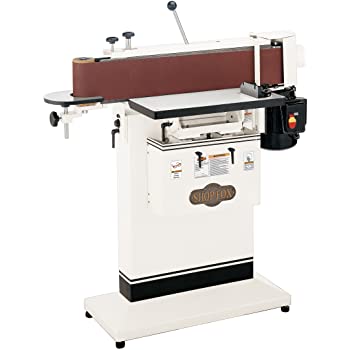
This is a horizontal/vertical edge sander which means that the sanding head, sanding belt, platen and idler roller tilt together from the vertical position, as seen in the photo, all the way back to a flat position 90 degrees from the vertical position. In this mode, a fence (included) can be attached to the front table to facilitate sanding the bottom side of a work piece. This edge sander can sand at zero degrees, 90 degrees or anything in between. This enables the operator to create bevels and even compound miters with ease.
The belt tensioning and tracking adjustments on this edge sander are fairly easy. The platen is made out of precision ground steel. The front table moves up and down. There is a 4 dust collection port. The end table is adjustable vertically across the width of the belt.
Included with this edge sander are a miter gauge that runs in a track in the front table and a metal fence, mentioned above, for sanding in the flat position. Sanding belts used by this edge sander measure 6 x 89, a bit smaller than the Delta edge sander above. Platen length is just under 3 feet. The front table measures 32 x 7 and tilts 90 degrees. Belt speed is 3900 feet per minute. Machine weight is 256 lbs., about half of the previous machine and is priced around $1069.
The Jet OES-80CS is an oscillating edge sander designed to reduce heat, burning and build-up, thus preserving the life of your sanding belts. This edge sander features a quick release lever for the release and tensioning of sanding belts as well as a tracking control dial. The precision-ground steel platen is covered with graphite to reduce belt friction which also helps with the longevity of your sanding belts. The front table moves up and down but does not tilt. The sanding head and related parts do tilt, however, enabling the sanding of bevels and compound miters. This edge sander uses sanding belts measuring 6 x 89. Front table size is 32 x 7. The machine weighs in at 258 lbs and has a price tag of about $950.
Like all Powermatic machines, this edge sander has a hefty price tag justified by top quality and innovative features. It is an oscillating edge sander which means that the sanding belt travels up and down 3/4 of an inch, 24 times per minute. This minimizes burning and lengthens belt life. Sanding belts can be expensive and so, over time, the oscillating feature should pay for the extra cost over a non-oscillating edge sander. Belt speed is 3542 FPM.
The front table has a vertical travel range of 8″. It can tilt inwards five degrees and outwards 45degrees. It measures a generous 48″ long and 11 3/4″ deep and the end guards can be removed so that boards longer than 48″ can be edge sanded. The end table tilts 40 degrees in and 45 degrees out. Ihe end table is half circle with an 18″ radius. The cast iron platen is covered by a graphite pad to minimize heat build-up and thus lengthen belt life.
The 9″ wide belts used by this machine are 3″ taller than the 6″ machines above. This means that not only can you sand taller workpieces, you have more belt surface to use between belt changes. The sanding head pivots on a large shaft with sealed ball bearings. There are (2) 4″ ports for efficient dust collection. A minimum 1,100 CFM dust collector is required.
This edge sander is equipped with a magnetic starter for safety. Belt measurement is 9″ x 138 3/4″. The machine measures 83″ L x 32″ D x 50″ H. It weighs 800 lbs. and ships at 870 lbs. Street price is about $4390.
SIDE-BY-SIDE COMPARISON CHART:
EDGE SANDERS
| DELTA 31-386 | JET EVHS-80CS | JET OES-80CS | POWERMATIC | |
| Approx. Price | $2463 | $1069 | $950 | $4390 |
| Motor HP | 3HP/220V | 1 ½HP/ 115V | 1 ½ HP/115V | 3 HP/220V |
| Belt Speed | 3150 FPM | 3900 FPM | 3900 FPM | 3542 FPM |
| Frt. Table moves | up,dn,fwd,bkwd | up & down | up & down | up & down |
| Adj. Head | yes | yes | yes | no |
| Spindle Sanding | yes | no | no | no |
| Belt Size | 6 x 10⁸ | 6 x 89 | 6 x 89 | 9 x 138 3/4 |
| Frt. Table Size | 35 3/8 x 12 | 32 x 7 | 32 x 7 | 48×11 3/4 |
| End Table Size | 11 3/8 x 8 7/8 | Not Stated | Not Stated | 19 x 12 |
| Dust Port | 4 | 4 | 4 | 4 |
| Weight | 500 lbs. | 256 lbs. | 258 lbs. | 800 lbs |
ALL ABOUT EDGE SANDERS
Over the years, Ive told many people that, next to the table saw, my edge sander has been the most utilized of all the woodworking tools in my shop. That may be because my woodworking designs always seem to have a lot of curved surfaces incorporated into them. While it is true that an edge sander can sand long, straight edges, I use it to sand inside and outside curves far more often than straight edges. With an edge sander, I can even sand large, round table tops using a jig with a pivot pin in the center. (See woodworking article on that subject on this web site.) My machine uses 6 x 10⁸ sanding belts and has about a three-foot platen surface. Outside curves are sanded on the front table and inside curves on the end table using the curvature of the idler drum. My edge sander does not oscillate and neither the front table nor the platen can be tilted. Most of the machines reviewed here are less limited than that.My technique is to mark the final profile to be sanded with a pencil line on the workpiece and then cut just outside of that line by about one blade width with the band saw or a jig saw. If the work piece is too large to manage on the band saw, I use the jig saw (sabre saw) to make the cut. After that, I use the edge sander to bring the work piece down to its final dimensions.
An oscillating edge sander keeps the sanding belts from loading up and burning by constantly moving the sanding belt up and down with reference to the work piece. An edge sander with a tilting front table or a tilting sanding head allows you to sand bevels and even compound angles.
If youve used edge sanders much, you know that, at a certain point, the sanding belt is going to go, announcing its departure from this world with some scary rumblings followed by a loud bang. I have never been hurt by this but I have always jumped away from the machine at the first sign of trouble. One good way to keep this from happening is to make sure that your sanding belts are no more than 6 months old because the glue that holds the lap or butt joint together tends to dry out and weaken with time. When ordering sanding belts, keep this in mind. Ordering sanding belts in large quantities may not a bargain in the end if you are ordering more sanding belts than you can use up in 6 months. Butt jointed sanding belts will leave a smoother finish but lap joints are much stronger and less likely to come apart. Another explosion-avoidance technique is to, whenever possible, avoid sanding sharp, pointed edges that can tear into the sanding belt and rip it up. If your machine has a coating on the platen, such as graphite, that will help reduce the friction between the back of the belt and the platen which will reduce heat buildup that shortens the life of your sanding belts.
Dust collection on any edge sander is an absolute must and the dust collector must be large enough to handle any amount of sanding dust that might be created by your edge sander. If you dont already own a dust collector that can suck up at least 600 cubic feet of air per minute (or more) you will have to add the cost of that machine onto the cost of the edge sander. So, when considering the cost of an edge sander, make sure you are looking at the total cost, not just the cost of the edge sander itself.