QUICK NOTE: To buy any product reviewed below, click on the Buy Now button to go directly to the appropriate page on another secure site to get more information on that product and/or make a purchase. The “Bob’s Pick” logo below indicates which of the products below has earned Bob Gillespies highest purchase recommendation. Below the reviews is a SIDE-BY-SIDE COMPARISON CHART and, finally, an article by Bob Gillespie on important features to consider when shopping and why.
DELTA 6 VARIABLE SPEED BENCH JOINTER

I do not recommend this machine except for making shallow cuts on short boards. Hobbyist woodworking tools like this one are fine for very light work but almost useless in a normal woodworking shop. This jointer should be firmly fastened to your bench top to prevent it from tipping over because of its light, 35-pound weight. The reasons for this are three-fold: (1) The entire table top of this jointer, including both the infeed and outfeed tables is only 30 long. This should not be a problem if your board is only 30 long. However, you try to joint an 8-foot piece of lumber on this little jointer, it might tend to tip up as it enters the in feed table and tip down as it exists the out feed table, raising it above the cutter knives, thus insuring a bad cut. (2) The cutter head on this jointer has only two knives. The more knives, the smoother the cut. I like to see a minimum of 3 knives in a cutter head. (3) The motor is only 10 amps in size, meaning that only shallow cuts are possible. On the plus side, this jointer has variable speed which is a nice feature on any jointer because better cuts can be made at different speeds, depending on the type of wood being jointed. Street price is about $290.
JET JJ-6CS CLOSED STAND JOINTER
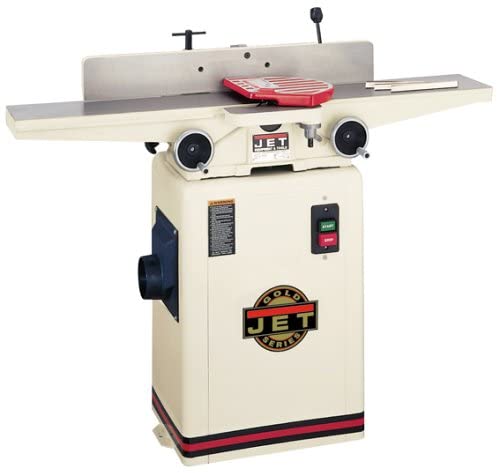
This machine is probably the smallest I would consider using in a home woodworking shop for edge-jointing small to medium length lumber for glue-up. It has a 48 overall bed length which should be sufficient for jointing 4 to 6-foot lumber and possibly 8-foot lumber with great care not to let the board tip. Its 6 cutter head means more frequent blade changes but if this machine is only used occasionally, this should not be an important limitation. The machine has a 1-horsepower, industrial-type motor which is adequate for light to medium depth cuts. The 3-knife cutter head turns at 4800 RPM, making 14,400 cuts per minute possible. The fence tilts two ways with positive stops at 90 degrees for jointing and 45 degrees for chamfering. Rabbet cuts as deep as ½ can be made thanks to a rabbeting ledge built into both tables of this jointer. The closed base and 4 dust collection port helps keep your shop from being littered with chips. I like the two, large adjustment knobs located right out front on the left side of the machine. Both the infeed and outfeed tables are adjustable which means that you can make fine knife height adjustments with reference to the outfeed table on without having to adjust the jointer knives themselves. The table ways are dovetailed, assuring accuracy over the life of the jointer. The centrally located fence controls are within easy reach. Street price is about $550. This jointer is also available in a model JJ-6CSDX for those whod like to save time and effort changing knives, time that could have been better used for production. Jets exclusive auto-quick-set mechanism allows you to re-set knives in far less time than required by similar machines. Except for this feature, this jointer model is identical to the Jet JJ-6CS and has a street price of about $750.
JET JJ-8CS 8 CLOSED STAND JOINTER

With this jointer, we move into the world of 8 machines with larger motors and longer beds. The price has increased, although reasonably, considering the improvements over the 6 machines reviewed above. In general, this jointer is similar in function to its smaller brothers, it is simply bigger, better and more powerful. Hand wheels with locking knobs are located underneath the tables at the front and rear of the machine.
One of the most noticeable improvements is an increase from a 1 HP 115v to a 2 HP 220v motor. The extra 2 of knife width means a longer time between blade changes. The overall table surface is 66 ½ long and the 4-inch tall fence is 38 1/2 long. Jointing of 8-foot lumber is without problems. The jointer fence tilts both right and left to 45 degrees in both directions and has positive stops at 45 and 90 degrees. The Jet JJ8-CS 8″ jointer produces over 16,500 cuts per minute with 3 knives. Street price is about $1300.
POWERMATIC 8 PARALLELOGRAM JOINTER

The Powermatic brand has always been synonymous with top-quality woodworking machines, priced accordingly. This is a 2 HP 220v, 8 jointer like the Jet model immediately above. The difference is in the extra measure of quality. Right away, I noticed that the bed is a whopping 82 long which means straight joints on 10 to 12 foot lumber without loss of control. Powermatic offers a unique Parallelogram design that assures maximum close proximity between the tables and the cutter head for an improved finish at any depth-of-cut adjustment. This feature also assures that the infeed and outfeed tables on this jointer will remain in perfect alignment with each other after years of rough use. This Powermatic jointer comes standard with a 2 HP, 220v, single phase motor but is also available with a 3 HP, 3-phase, 220v motor at extra cost. Fence tilt adjustments are by hand wheel and extend left or right 0-45 degrees. The 3-blade cutter head executes 21,000 cuts per minute. Street price is about $2000.
POWERMATIC PJ1696 16 PARALLELOGRAM JOINTER

Just to see what a big industrial jointer looks like, lets take a peek at this 16-inch jointer by Powermatic. This is probably way more than most woodworking shops would ever need or could ever justify but for a large production shop, this giant jointer may just be the ticket. The huge, 16 cutter head width insures long intervals between knife changes.
This machine has what is known as a helical head which means that there are 58 two-sided small blades that are inserted into slots in the head in a spiral-like pattern. There are two additional knives used for rabbeting. This type of head produces extremely smooth cuts up to a maximum depth of ¾.The 5200 RPM speed of cutter head rotation gives you 20800 cuts per minute. The tables include rabbeting ledges for cutting rabbets as deep as ¾.
A 96 bed assures smooth cuts along long lumber and easy lumber handling. The standard motor is 7.5 HP, 3-phase wired for either 230 or 460 volts. The machine weighs in at 1280 Lbs. with a shipping weight of 1400 Lbs. 800 CFM dust collection (minimum) is required through a 6 dust port in the enclosed cabinet. Street price is around $7809.
SIDE-BY-SIDE COMPARISON CHART: JOINTERS
| Delta 6″ | Jet 6″ | Jet 8″ | Powermatic 8″ | Powermatic 16″ | ||
| Bench Top | JJ-6CS | JJ-8CS | Parallelogram | Parallelogram | ||
| Jointer | Jointer | Jointer | Jointer | Jointer | ||
| Cutter Width | 6″ | 6″ | 8″ | 8″ | 16″ | |
| Table Length | 30″ | 48″ | 66.5″ | 82″ | 96″ | |
| Motor | 10 Amp | 1 HP | 2 HP | 2 HP | 7.5 HP | |
| No. Knives | Two | Three | Three | Three | Helical | |
| Weight | 35 Lbs. | 258 Lbs. | 398 Lbs. | 616 Lbs. | 1280 Lbs. | |
| Street Price | $290 | $750 | $1300 | $2000 | $7809 |
ALL ABOUT JOINTERS
The principal function of a jointer is to put a straight, smooth, level edges on boards in preparation for edge-to-edge glue-up.
Rabbeting can be accomplished on some jointer models but I prefer to use the table saw for this task. Chamfering, or making angled cuts, can be performed on these woodworking tools by tilting the fence. Accurate jointing or chamfering requires that the cutter head knives in these machines be adjusted precisely with reference to the outfeed table. The edge of each cutter head knife must be exactly at the level of the outfeed table: not above or below it.
In most cases, sharpening the cutter knives requires that they be removed completely from the jointer cutter head and then replaced and adjusted after sharpening. This is why I recommend the use of solid carbide as opposed to high speed steel knives in a jointer: Carbide lasts a lot longer and that means less time and effort has to go into removing, replacing and adjusting knives. Buy two sets. That way, you can continue to use your jointer while the dull set is out for sharpening and you will always have a sharp set waiting. Come to think of it, you should consider doing this with all of your woodworking tools: extra blades on hand for the table saw, band saw, circular saw, etc. will keep your shop running smoothly and continuously.
Always unplug your jointer from electrical current before attempting any adjustments to the knives. In my jointer, an 8 Rockwell/Delta classic, the knives are removed and replaced by using a flat wrench that came with the machine. This wrench is used to loosen and tighten the hex head machine screws that press against the knives and hold them in place in the cutter head of the jointer. It is very easy to round over the hex heads, so I am very careful not to do so.
I purchased a gadget that helps me align the knives with reference to the outfeed table of the jjointer. It magnetically attaches itself to the surface of the outfeed table and magnetically attracts the knives upwards and holds them in position while I tighten the hex bolts. Each knife (there are 3 in my machine) must be in the extreme vertical position before it can be individually correctly adjusted and tightened. When all 3 knives have been set properly, they should just touch, but not lift, a flat piece of wood laid on the outfeed table, extending over the cutter head of the jointer. They must do this across the entire width of each knife.
Today we tool a look at a wide range of jointers. Jointer size is most commonly determined by the full width of the cutter head. A 6 jointer makes a maximum 6-wide cut. An 8 jointer makes a maximum 8 cut and so on. It would be rare to use the entire width of even a 6 knife at once: The real advantage of wide blades is that you can move the fence across the jointer bed to use a sharper place on the knives when part of the knives becomes dull. The wider your knives, the more use you will get out of them before it is time to re-sharpen. I usually start with a sharp knife and adjust the fence all the way to the right end of the cutter head. I can then move the fence to the left, in increments a bit wider than the maximum board thicknesses, until the knife edges are dull across their entire width.
Sometimes, with curly or wavy grain structure, you will experience tear-out from the lumber edge even with sharp knives. Sometimes you can turn the board around and run it through again with very shallow cuts until the edge is fully jointed and the tear-out is gone. At other times, you may have to settle for a sawn joint made on the table saw. Usually you can make fairly good glue joints this way, if you have to, but a edge made on a jointer is always my first choice.
The depth of cut is determined by the height of the infeed table with reference to the outfeed table. The lower the infeed table, the more wood is removed with each pass over the jointer. It is not a good idea to take off too much wood in a single pass. The chances of tear-out increase with the depth of cut and you may end up removing more precious wood than you really need to, to get your perfect joint.