I have used several of these in my shop in recent years and I’ve been quite satisfied with them in general. While their light weight is a blessing, they are a bit tall (top heavy) for my liking. I have used these both as bench routers and in router tables and they have had more than adequate power for anything that I have thrown at them. I even used one to spin a half-inch spiral bit in a JDS Multi-Router and made dovetail joints, mortises and tenons with ease.
This wood router draws 12 amps and has a wide variable speed range of 8 to 25 thousand RPM. It features coarse and microfine depth adjustment, a tool-free template guide adapter and its precision centering design centers the bit precisely. It has a large 3 ¾” base opening plus a 2” sub-base opening so it can handle large bits. You can set the wood router motor in its base in either direction so that the on/off switch will be near either your left hand or right hand. This is possible because the router motor does not turn while being adjusted up and down.
Its ball-shaped, hardwood handles, while pretty, leave a bit to be desired in terms of grip and considering the height of this router, that’s important. Bosch has designed this wood router motor with a one-piece armature shaft for accuracy and long bit shank capability and has included Constant Response ™ circuitry to maintain constant speed under heavy loads. Included with this wood router are ¼” and ½” self-releasing collet chucks and a 3/8” collet chuck is available at extra cost. This Bosch wood router comes with two wrenches, a tool-free template guide adapter, a 10-foot cord and a chip shield.
DEWALT DW618 2 ¼ HP EVS WOOD ROUTER
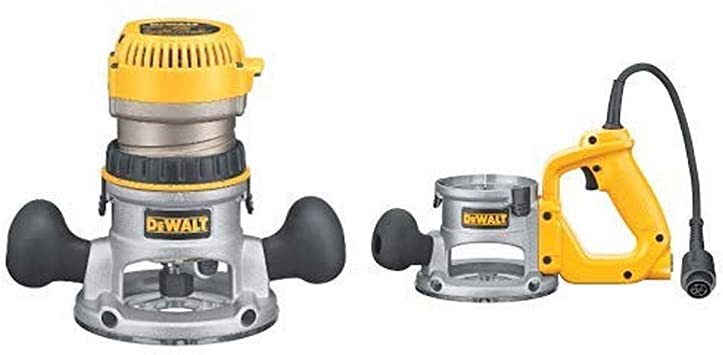
The thing I like most about this wood router is its low profile (low center of gravity) and its comparatively light weight (10 Lbs.). This, along with the router’s rubber-coated oval (not round) handles mean you have firm control during critical cuts. Its 12 amp motor is more than adequate for most tasks and its electronic variable speed mechanism keeps the wood router spinning at a constant speed anywhere in a range from 8,000 to 24,000 RPM.
The microfine adjustment ring allows incremental height adjustments as small as 1/64 inch while raising or lowering the wood router vertically in its base. This wood router does not turn while going up and down, so the dust-free switch is always located in the same place relative to the handle grip. This means that you can easily turn the wood router on and off while hanging on tight to the machine.
A motor cam lock and quick release motor latches make gross height adjustments and motor removal quick and easy. This wood router comes with a sub-base concentricity gauge for perfect centering of template guides with relationship to the bit shank. It has a spindle lock so bit changes require only a single wrench. It’s clear, LEXAN sub-base lets you see the router bit while it is cutting. You can set the switch and cord set up for right or left-handed use.
MILWAUKEE MODEL 5616-20 2 ¼ HP BodyGrip® WOOD ROUTER
For the most part, I have used Milwaukee routers for router table applications simply because they tend to be a bit large and heavy for hand-held use. This wood router may be the exception to that rule because of its new, BodyGrip® feature which allows the operator to grasp the wood router firmly around its middle with either hand, while hanging on to the handle on the opposite side with the other hand. The grip also includes a hand strap so that the wood router can’t get away from you even if you lose your grip.
One thing I have always liked about laminate trimmers and small routers is that I could grip them around the middle which eliminates all chance of tipping during cutting. Notice the black knob at the upper left-hand corner of the router. This is the fine depth adjustment which moves the router motor via gearing and a threaded screw. If you want to release the router motor or make gross height adjustments simply operate the black lever visible along the left side of the router base.
The router sub-base contains a hole through which one can insert a 3/8” hex for “above the table” height adjustments in a router table. The geared microfine adjustment, the quick motor release lever and the “above the table” height adjustment make this an ideal wood router for all but the heaviest router table applications. And, the BodyGrip® feature makes this a good hand-held router as well!
PORTER CABLE MODEL 892 2 ¼ HP WOOD ROUTER
I hate to sound like a broken record but the height and weight (13 lbs.) of this Porter Cable wood router makes it potentially difficult to control. The oval, rubber-coated handles should help in this regard, however. With the electric cord up at the top of this skinny/tall wood router, you want to make sure that the cord is free to move with the wood router during a cut.
This wood router is soft-starting, has a 12 amp motor with electronic speed control and has a variable speed range from 10,000 to 23,000 RPM. The router motor transitions quickly from the fixed base (included) into the optional, extra cost, plunge and spiral bases that are available from Porter Cable.
The on/off switch is accessible from one of the handles and the router “locks off” electric power to the motor when you are changing bits. Only one wrench is required for bit changes because of the integrated spindle lock. Microfine depth settings are accurate to 1/128”. There is also a macro height lever for coarse adjustments and releasing the motor from the base.
SIDE-BY-SIDE COMPARISON CHART: WOOD ROUTERS
| FEATURES | BOSCH | DEWALT | MILWAUKEE | PORTER- | |
| CABLE | |||||
| Model Number | 1617EVS | DW618 | 5616-20 | 892 | |
| Approximate Online Price | $180 | $160 | $179 | $200 | |
| 1/2″ Collet | X | X | X | X | |
| 1/4″ Collet | X | X | X | X | |
| 3/8″ Collet | Available | ||||
| Above Router Table Adjustment | Available | X | X | ||
| Base Type | Fixed | Spiral | Fixed | Fixed | |
| Bit Changing Power Lock-off | X | ||||
| Calibrated Depth Control Ring | X | ||||
| Cam-lock Height Lock | X | ||||
| Case | X | ||||
| Chip Shield | X | ||||
| Clear Sub-base | X | ||||
| Detachable Cord Set | X | ||||
| Dust-sealed Switch | X | X | |||
| Electronic Speed Control | X | X | X | X | |
| Flat-top Design (For Bit Changing) | X | ||||
| Handle Access On/Off Switch | X | ||||
| Hardwood Handles | X | ||||
| HP | 2.25 | 2.25 | 2.25 | 2.25 | |
| Low Center of Gravity | X | ||||
| Macro Height Lever | X | X | |||
| Micro Adjustment Knob | X | 1/64″ | 1/64″ | 1/128″ | |
| Motor Amperage | 12 | 12 | 13 | 12 | |
| Motor Contamination Shield | X | ||||
| Motor Diameter | 3.25″ | 3.5″ | |||
| One-piece Armature Shaft | X | ||||
| Padded Body Grip | X | ||||
| Quick-Clamp Motor Release | X | ||||
| Quick-Release Motor Latches | X | ||||
| Right or Left-hand Switch | X | X | |||
| RPM Range | 8000-25000 | 8000-24000 | 10,000-24000 | 10000-23000 | |
| RPM Variable | X | X | X | X | |
| Rubber-molded Handles | X | X | X | ||
| Self-releasing Collets | X | ||||
| Soft Start | X | X | X | ||
| Spindle Lock (One Wrench) | x | X | |||
| Sub-base Concentricity Gauge | X | X | |||
| Template Guide Adaptor | X | ||||
| Two Wrenches | X | X | |||
| Weight | 10.0 Lbs. | 10.0 Lbs. | Not Stated | 13.0 Lbs. |
ALL ABOUT WOOD ROUTERS
The wood router is essential among woodworking tools because it adds decorative detail that enhances and defines the final appearance of your woodworking project. Used correctly, the wood router is to the woodworker what a fine paintbrush is to an artist. It’s all in the details. In this review, we will look at 2 1/4 horsepower routers from Bosch, DeWalt, Makita Tools, Milwaukee and Porter Cable.
There are four, basic types of wood routers on the market today: laminate trimmers, lightweight or low-powered routers in the 7/8 to 1 1/2 HP range, medium-powered routers in the 1 ¾ to 2 ¼ HP range and high-powered routers in the 3-4 HP range. Each has its use and I have owned all of them at the same time. The laminate trimmers do what their name implies as well as other light-weight tasks such as making hinge mortises. They are only suitable for small router bits but they are easily maneuverable and fit nicely right in your palm. If you need more horsepower but still like the ease of a lightweight router, the 7/8 to 1/12 HP routers will do a fine job of spinning router bits up to ½” radius round-over bits. Every shop should have one of these handy for bench-top work. They are a bit small for router table use. The 2¼ HP wood routers we will reviewed above have sufficient power to spin large router bits through hardwood and yet they are still light enough to be manageable as a bench-top wood router. While any wood router over 2 HP can be used in a router table, I prefer the high powered ones for that application because there is no need to worry about how heavy they are and you might as well have as much power handy as you might need. Most, but not all, of these large woodworking tools are plunge routers. The high horsepower is necessary to plunge large bits deep into hardwood to make mortises and the like.
If I could only afford one wood router, it would be the 2 ¼ HP variety because it is light enough for most bench-top work and can also be used in a router table. If I could afford two routers, I would probably have a 7/8 to 1 ½ HP wood router for bench-top work and a 3 ½ HP wood router under my router table. I don’t like mounting and dismounting routers under my router table, so having a lighter wood router on hand near the bench at all times really speeds things up.
Before we get into reviewing these routers , I’d like to make a few observations about these woodworking tools, in general.
First, I suggest you consider using only high-quality carbide-tipped router bits in your wood router whenever possible. They can be re-sharpened many times and they usually don’t burn up and load up if they are kept sharp. High-speed steel bits don’t last long, they are not worth sharpening and they dull quickly, burning your workpiece as they soon load up and turn black from burning. Sometimes, however, the bit profile you need may only be available in a high speed steel bit but this is the exception rather than the rule.
Second, as hand-held power woodworking tools, heavy and/or top-heavy routers are hard to manage. Not only will you be struggling with them all day, they tend to tip easily which can often ruin a cut or leave an incomplete cut. If a smaller, low-profile wood router could have spun that bit, then that is the wood router you should have been using. On the other hand, an under-powered wood router will not do a good job and may not even be safe. Also, be sure to check the weight of any wood router you may be considering, if it is to be hand-held. Heavy woodworking tools are tiring and clumsy to use all day long. A pound or two less can make a big difference.
Third, consider how you will be hanging onto the wood router while it is cutting. Are the handles comfortable enough for continuous use? Do the shape and material of the handles allow you to control the wood router properly. Some of the woodworking tools we will review today are also available with “D” handles (at extra cost) which may give you better control and feel. One wood router here even offers a padded grip around the exterior of the router base. One hand goes on the rubber grip while the other goes on a conventional knob.
Fourth, if your wood router is in the 2 1/4 HP range, like the wood routers reviewed here, you will want it to have a variable speed feature, especially if you are planning on using large bits like raised panel bits. You will need to run these large bits a bit slower. They will stay cooler and cut better at a lower speed. On the other hand, you will get smoother cuts with small bits of you keep the speed high. No matter what RPM you choose, you will want your wood router to be able to maintain that speed at all times, no matter how hard you push it. Electronic speed control allows your wood router to compensate for heavy loads by automatically adding a sufficient amount of extra power to keep your wood router spinning at the same speed it was before the cut began.
Fifth, (and this is a safety consideration) try to buy a wood router that has “soft” start-up. This would not be a needed feature in stationary woodworking tools but is an important safety device in a hand-held wood router. Historically, routers have had only one speed (high) and when you turn them on, they spin up quickly and the gyroscopic force of that can flip a spinning wood router right out of your hands. A soft start-up wood router gradually increases its speed from zero to full, thus eliminating almost all of the gyroscopic effect.
Sixth, if you are going to be changing bits all the time, consider what steps you will have to go through to accomplish that task. Some routers have a shaft lock button so you only need one hand to hold down the button and one wrench to turn the collet nut. I’m kind of used to the two-wrench variety. I usually take the router motor completely out of its base, lay it on its side on the table, putting one wrench on the flat part of the shaft and the other wrench on the collet nut. If I am loosening the collet nut, I will first lower the shaft wrench to the table top and then push down towards the bench with the wrench that’s on the collet nut. If I am tightening the collet nut, I will put the collet nut wrench down to the table top and then push down against that with the shaft wrench on the flat part of the shaft.
If you’ve used routers at all, you must have noticed that when you are loosening a collet nut, you will feel resistance at the start of the turn of the wrench and then it will turn freely for a while before resisting the wrench one more time. The first resistance comes from loosening the nut itself. The nut then unscrews a bit down the thread and then it begins to push against the collet, releasing it from the shaft of the router bit. When you are tightening a bit into a wood router, you will feel resistance only once as you squeeze the collet around the shaft of the bit while turning the nut as far as it will go.
Some people like to change router bits with the wood router upside down on the table with the two wrenches sticking out to the side. In this case, the technique is to arrange the wrenches so that you can squeeze their handles together with one hand to loosen, or tighten, the collet nut. For these people, some manufacturers make routers with flat tops. If find this way to be a bit more clumsy than laying the wood router down on the bench and there is less leverage in case of a stuck bit.
Seventh, router bits come in three shank sizes, 1/4”, 3/8” and 1/2”. The half-inch shank bits are only slightly more expensive than the quarter-inch ones and yet, they give you a distinct advantage. With a larger diameter shank and a larger diameter collet, there is much less chance of slippage under heavy loads. Consider buying only ½” shank bits, especially if you are spinning large cutters.
Eighth, some of these routers offer “above router table” height adjustment capability. This is usually accomplished by sticking a hex T-wrench into a hole provided. It’s hard to adjust the height of a wood router accurately from underneath a router table while on your knees, fighting gravity. An even more elegant solution is to purchase a router lift for your router table. If this interests you, check out my article on this site entitled “How to Build Your Own Router Table.”
Ninth, there are three types of wood router bases: conventional, spiral and plunge. In a conventional fixed base, the router motor just slides straight up and down in the base and is clamped into position. The spiral-type base has an adjustment ring that turns in a spiral groove cut into the outside of the router motor casing, thus raising or lowering the router motor relative to the base. A plunge router base clamps onto the router motor and then pushes the wood router and router bit down unto the work piece from above. Some routers are offered in kits containing two or more types of bases so that you only need to buy one router motor for a variety of uses.
Tenth, some of these woodworking tools gauge and control their fine depth-of-cut with a spiral ring while others utilize a geared shaft attached to a calibration knob. All routers have a means of making gross height adjustments by releasing the lever or cam that locks the router motor into the base. Once adjusted to a position close to the final position, the fine depth-of-cut adjustments can be made in increments as small as 1/64 of an inch and, in the case of one router reviewed above, 1/128 of an inch.
Eleventh, consider that motor amperage is usually a better indicator of motor power in woodworking tools than stated horsepower. All off the routers reviewed in this article claim to develop 2 ¼ HP but their amperage (electrical power used) varies from 11 to 13 amps.
Twelfth, and finally, there are some less important (to me) but nice features available on some, but not all, of these woodworking tools including: the availability of a 3/8” collet, an automatic motor power lock-off during bit-changing, a carrying case, a clear plastic sub-base for better viewing, a detachable cord set, a dust proof switch, a switch that can be located left or right for the comfort and convenience of the operator, oval, rubber-molded handles, self-releasing collets and a way to fine adjust the sub-base so that it is exactly centered around the bit shaft. This means nothing if you are only using ball bearing router buts but if you are using router guides mounted around the bit shaft, it is vitally important that the bit shaft be centered within the guide. If your bit is not perfectly centered when using template guides, your cut will move from side to side as you turn the router around while cutting. Since the guide is mounted to the sub-base, the hole on the center of the sub-base must be concentric with the router bit shaft.
Be sure to check out the SIDE-BY-SIDE COMPARISON CHART immediately below the reviews and abo0ve this article. If you know which features are most important to you, you will be able to quickly determine which of these woodworking tools is the best wood router for you.
is azithromycin in the penicillin family
amoxicillin tooth infection reddit
canadian pharmacy cialis paypal